
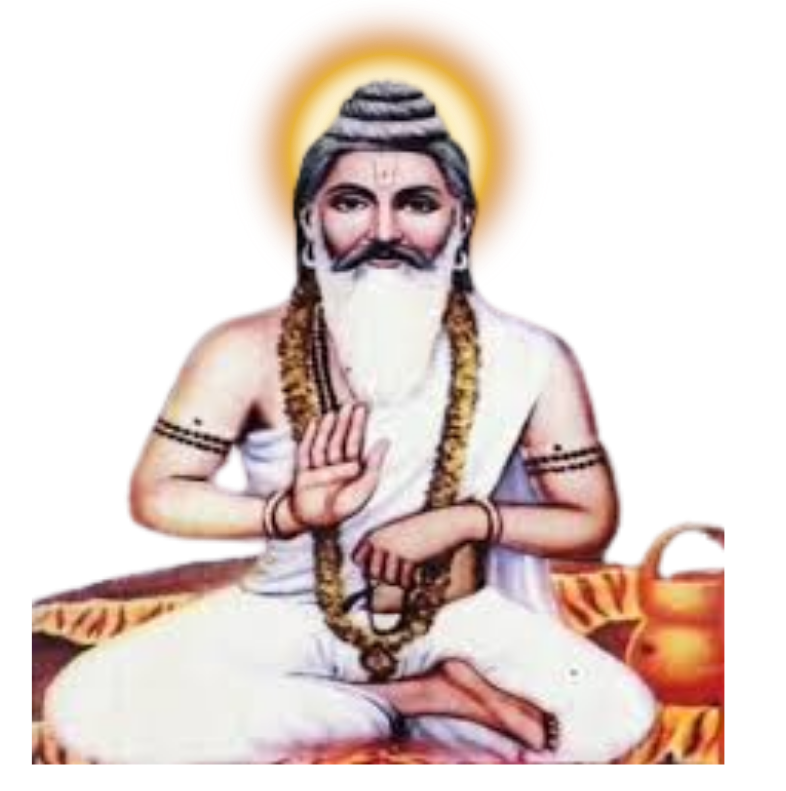
Baba Jhunja Ram Ji was a man of a wandering nature. Wherever he was invited with respect, he would certainly visit. In a village called Vahlakhan, an elderly man held Baba Ji in high regard, often inviting him and insisting, “Whenever you pass this way, you must grace our home with your presence.”
One day, following his wandering spirit, Baba Ji reached that village and went straight to the elderly man’s house, calling out his customary greeting, “Jai Ram Ji!” The master of the house, that same elderly man, was severely ill and unable to get up. The other adults were away at work, and only the children were playing in the room. Unable to rise or speak loudly, the old man told the children, “Listen, I hear Baba Jhunja Ram Ji’s voice outside. Go, give him a seat, help him wash his hands and feet, and offer him refreshments. Then bring him to me.”
The children went outside and saw a man with a heavy build, a long beard, dressed in white, with a satchel slung over his shoulder. Seeing his appearance, the innocent (yet mischievous) children forgot to welcome him. Instead, they began clapping their hands and laughing loudly, chanting, “Jhunja oye, Jhunja o!” as they danced around him.
Thinking the children were alone and simply didn’t recognize him, Baba Ji decided to leave the courtyard. Hearing the commotion, children from neighboring houses joined in. Driven by a sense of mischief, they followed him, clapping and mocking him. Baba Ji skipped the other houses and headed for the main road. Soon, a mob of children gathered, and their chant changed from “Jhunja” to “Hoonja oye, Hoonja oye!” (implying a ‘sweep’ or ‘wipeout’). They began pelting him with dirt, clods of earth, and stones. Baba Ji tried to stop them, but the children were caught up in their prank.
Struck by stones and clods, the heavy-bodied Baba Ji began to run. For the children, watching him run was a spectacle. Unfortunately, due to some ill fate, no one in the village noticed the children’s behavior. The chase continued until they reached the village outskirts. When the children refused to stop, a panting Baba Ji muttered, “Jao, hoonja phir jaye” (“Go, let the sweep/wipeout happen”).
It was evening, and the villagers were busy with their chores; no one saw or heard the event. Having gained some distance, Baba Ji hid in a thicket of bushes to catch his breath. Seeing him vanish, the children returned home, laughing.
As evening fell, the villagers began milking their cattle. To their shock, many animals gave no milk, while others gave only a fraction. Suddenly, children began suffering from vomiting, diarrhea, and fever. Soon, the elderly and the youth were also stricken. Not a single house was spared. The situation was so dire that in many homes, there was no one healthy enough to even offer a glass of water. Domestic remedies like decoctions (kadha) failed completely.
In the elderly man’s house, where no one was fit to serve water, the old man asked, “Did Baba Jhunja Ram arrive today? Did anyone welcome him?” When questioned, the suffering children admitted that they had chased him away with stones, mocking him as “Hoonja.”
The old man realized the cause and alerted the village. “This is the fruit of insulting a saint! The children mocked him with ‘Hoonja’ (wipeout), and now the whole village faces a wipeout. Look at us—children, elders, and cattle are all dying. Go, find him!” People ran in all directions to neighboring villages, but Baba Ji was nowhere to be found. The village spent the night in agony and tears.
Meanwhile, exhausted from running, Baba Ji had spent the night sleeping in the bushes. In the morning, he completed his daily prayers and rituals and walked toward the next village.
When he reached the next village, the locals told him, “Baba Ji, the people of Vahlakhan were searching for you all night. The entire village, including the livestock, has fallen deathly ill.” Baba Ji simply remarked, “Phir gaya na hoonja, ab kya kare Jhunja” (“The wipeout has happened, what can Jhunja do now?”).
Soon, the search party from Vahlakhan found him. They fell at his feet, begging for forgiveness for the children’s sins. Baba Ji replied, “I care nothing for honor or insult, but your children wanted a ‘Hoonja’ (a clean sweep) of the village, so what could I do?”
Moved by their pleas, the compassionate saint gave them sacred ash (Vibhuti) from the penance site of Baba Nakodar Das Ji. He instructed: “Fill a pot with fresh well water and mix this ‘Reen’ (ash) into it. Have every household take a bit of this water, mix it into their own fresh pots, and sprinkle it throughout their homes. Give three sips to the sick and sprinkle it on the cattle and stables. Pray to Baba Nakodar Das Ji; he will surely show mercy.”
Upon following his instructions, the cattle began giving milk again, and within a day or two, the entire village was restored to health. The elderly man also recovered. Through the spiritual power of his penance, the respect for Baba Jhunja Ram Ji grew immensely. Following the core principles of his Guru, Baba Nakodar Das Ji, Baba Jhunja Ji also dedicated the rest of his life to the service of humanity.